Sunday, March 11, 2012

How airspace is constructed and controlled


Key 1:


The airport tower controls the aircraft on the ground before takeoff and then about 5 miles from the tower, when the tower transfers aircraft control to a terminal Radar Approach Control facility (TRACON). Controllers I the airport tower either watch the aircraft without technical aids or use radar Airport Surface Detection Equipment for aircraft on the surface and airport surveillance radar for those in the air. Central Flow Control can order the tower to hold flights on the ground id demand exceeds capacity at the arrival airport.


Key 2:


The TRACON which may be located in the same building as the airport tower, controls aircraft from about 15 miles to about 30 miles from the airport, using aircraft position information from the aircraft surveillance radar. The TRACON the transfers control to an Air Route Traffic Control Center (ARTCC).


Key 3:


ARTCCs control aircraft that are en route between departure and arrival airports. Each ARTCC controls a specific region of airspace and control is handed off from one ARTCC to another when a boundary is crossed. Aircraft positions are detected by the air route to an Air Route Traffic Control Center (ARTCC).


Key 4:


The TRACON controls the arriving aircraft until it is within about 5 miles of the arrival airport tower, when control is transferred to the tower.


Key 5:


The airport tower controls the aircraft on the final portion of its approach to the airport and while it is on the ground.

Friday, February 24, 2012

What is the different between accident and incident?

Accident is an occurrence associated with the operation of an aircraft that takes place between the time any person boards the aircraft with the intention of flight and the time all such persons have disembarked and which any person suffers a fatal injury, serious injury or the aircraft receives substantial damage. On another part, incident has to happen first like a symptom before sick. Incident is an occurrence other than accident associated with the operation of an aircraft that affects or could affect the safety operations. Incidents are events that can be defined as near to accidents. All accidents started as near accidents.

Accident can cause a fatal injury, serious injury and substantial damage to the aircraft. Fatal injury results in death within 30 days. The examples of fatal injury are on Malaysia Airlines (MAS) flight 653 crashed at Tanjung Kupang, Johor on 4th December 1977. It was the deadliest and first fatal accident for MAS with all 93 passengers and 7 crew was killed. The flight was apparently hijacked when it reach cruised altitude. On another view, substantial damage affects structural strength of aircraft, performance or flight characteristic that need major replacement of affected components. Another example is on 15th September 1995 when Malaysia Airlines (MAS) flight 2133, a Fokker-50 crashed during approach in Tawau, Sabah due to pilot error and 34 people were killed. According to investigation report, the accident was probably caused by the pilot’s poor in flight decision making and failure to follow standard operating procedures. The report also pointed out the failure of the co-pilot to alert the captain of unsafe manoeuvre or take over control of the aircraft.

The various combinations of possibly unsafe acts and conditions that occur each day usually end as incidents rather than accidents. The examples of incidents is Malaysia Airlines flight-124 on 1st August 2005, a Boeing 777-200ER departed Perth for Kuala Lumpur. Climbing through 38,000 feet a faulty accelerometer caused the aircraft's Air Data Inertial Reference Unit (ADIRU) to command changes of altitude. The flight crew overrode the ADIRU and manually returned to land the aircraft at Perth. Subsequent NTSB investigation led the US FAA to issue emergency airworthiness directive 2005-18-51 on the fly-by-wire software. Another example is on 2nd October 2009, MAS Boeing 737-400 (9M-MMR) was substantially damaged when the port main undercarriage collapsed while the aircraft was parked at the gate at Kuching Airport.

Tuesday, February 21, 2012

Changes in marketing environment affects the airline industry


The classification of marketing environment distinguishes between PESTE Analysis which are politic, economic, social, technology and environment. Airlines business will affect when there are changes in PESTE. As early example, let’s look into what happens to Syria now. Before this in a year 2009, Syria tourism has accounted for 11 per cent of Syria's gross domestic product (GDP) and Syria is received 5.4 million visitors per year on average. A lot of interesting places can be visited in Syria such as Damascus City, Aleppo, Qala’ah Al-Husun and Homs. However, political uncertainty in Syria have caused many people are afraid to come to Syria. Even the death of civilians, children and women has also increased and showed that Syria is not safe to visit. The crisis has badly affected the Syrian Airline business, with many passengers in and out of Damascus reporting almost empty planes. Tourism has been the hardest hit of Syria's industries since the unrest began in March 2011. Syrian tourism minister, Lamia Aasi said tourism in May and June 2011 was down 60 per cent compared with the same period in 2010.


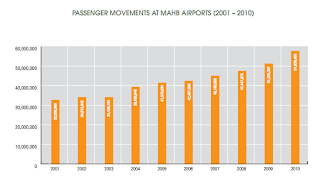
From the example above, it show political stability of the country is very important. Politic influenced the marketing strategy by showing other examples. Syrian Arab Airline has announced Asia plans to open new routes to India and China while dropping services to Europe for "commercial reasons". Other routes like Marseille and Milan will be suspended for economic feasibility considerations because they are not profitable. Vice versa, if a country’s position in political stable, they will attract more inbound passengers to the country and boost up the country economy. A good example is Malaysia. Although there were some riots happened, but it was not as bad as Middle East. It is proved by the increase in passenger movements at Malaysia Airports in the last eight years. The illustration one below shows the increase in passenger movements at Malaysia Airport Holding Berhad from 2003 to 2010.


On another side, political will also give impacts to the airline when government issued new rules and regulations. The latest situation that will relate is the new European Union (EU) carbon tax. Many countries opposed the EU carbon charges like China, India, Brazil and South Africa because it makes extra costs to the airlines. This caused airlines to raise ticket prices and a burden to passengers. China argues it is unreasonable to apply the levy to developing nations and wants the costs of reducing carbon to be passed on to aircraft manufacturers. In Singapore Air Show 2012, Singapore Airlines CEO, Goh Choon Phong said that ‘’we are objecting to the principle of how it is being applied, that it is applied to flights outside of Europe, to airspace outside Europe.’’ Furthermore, Cathay Pacific CEO of Hong Kong said that ‘’when people go it alone whether for good reasons or bad, troubles come and difficulties arise’’ Airlines opposed to the system say it would cost the industry 17.5 billion euros ($23.2 billion) over eight years.


Instead of airlines business making money, they also have social responsibilities to the public. For example, MASwings realises the importance of air transport to the community in Ba’kelalan, Sarawak and has always focused on providing safe, reliable and affordable services. As a Rural Air Service (ARS) operator, MASwings faced various operational constraints and resources including the limited number of Twin-Otter aircraft used for its operations into the Short Take Off and Landing (STOL) ports such as Ba’Kelalan, Bario, Long Akah, Long Banga, Long Seridan and Long Lellang. Although the RAS is not profitable to MASwings, but as a responsibility to the community, they still provides the operation to rural areas.

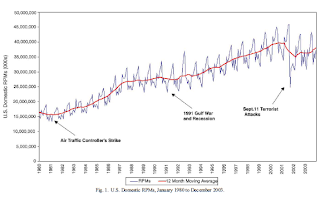
Moving to economic part, no industry has suffered greater economic damage from the terrorist’s attacks of 11 September 2001 than the US airline industry. The attacks caused many travellers to reduce or to avoid air travel. Illustration 2 shows decreasing in demand for passengers to travel during economic recession in US.

Sources: Journal of Economic and Business (2005)

On another part, infrastructure is one of the factors that influenced marketing environment. The needed of infrastructures in air transport simply because to accommodate growth in demand. When the government provided a large airport, the larger capacity passengers can inbound to the country. As for example, Survarnabhumi Airport, Thailand can accommodates 100 million passengers per annum while KLIA, Malaysia can only accommodates 40 million passengers per annum. Survarnabhumi Airport can provide services to 90 airlines while KLIA only can serve 58 airlines at this a point of time. Therefore, the larger infrastructure constructed the larger potential to cater the demand in air transport services.

In social factor, we have to learned countries characteristic to find business opportunities. Trends can be changed through changing tasted in holidays and also change in lifestyle. People will go on holiday if the economic is stable and financially incapacitated. Social and economic are interrelated to each other. A good example is Korean Tourism was booming because of Korean drama, Winter Sonata. Many tourists want to come to the Nami Island, the location where the Winter Sonata played. In additions, people would travels because of special interests like golfers, cyclists and medical. Golfers would be interested if they know the location of the golf courses is beautiful. They are going to play and money does not matter to them. Malaysia has organized Le Tour de Langkawi (LTDL) for several years. Therefore, I’m sure many cycling fans all around the world will come to Malaysia to support their pro cycling teams, continental teams and also country teams in LTDL.

Technology growth appears to be the driver in building a mutually satisfying air travel experience, from departure to arrival. The trend online buying allows passengers the freedom to do comparison and book a flight through the internet. For the airlines, it will reduce distribution costs. SITA’s 7th Airline IT Trends Survey found that more than 70% of airline tickets are now sold by the internet. It also found that more passengers will be using Web check-in and 60% of airlines will be using bar-coded boarding passes. In addition, new aircraft technology increased competitions between the airlines. On long-haul trips, Boeing’s 787 offered a wide windows as well as innovative seating for passengers, airframe materials, quitter engines, lower operating costs and fuel efficiencies for airlines. In low cost-carrier (LCC), JetBlue Airways was the frontrunner in installing video screens in every seatback and offering DirecTV services while AirTran is offering XM Satellite Radio. There is a growing demand especially on long-haul flights for the availability of communications technology.

Besides that, now airlines rely on eCommerce for many purposes. One primary benefit is it reduces the number of employees needed. Airlines save money through lower costs for reservations, sales offices, advertising, and agent fees and commissions. The cost savings are sufficient enough that they encourage customers to book flights online and penalize customers when they don't. Furthermore, airlines can save time when customers book their own flights. When fewer people tying up the phone lines, airlines can give better service to those who need help.

Online check-in also saves time by reducing the workload of the ticket agents. Another time-saver for both the airline and the customer is the use of e-tickets, printed at home or at an airport kiosk. Online booking makes it easier to offer additional services such as car rentals, hotel rooms, and vacation packages without resorting to high-pressure sales tactics. This is an opportunities for airline parallel with technology advancement. Airline ticket sites like Priceline, Travelocity and Expedia provide more opportunities for airlines to sell tickets. Airlines can offer discounted tickets based on availability. Last but not least, eCommerce is simplified management of rewards programs with online booking. Customers can enter their rewards information and track their miles and rewards online. Customers are also more likely to sign up for a rewards program online than if they have to fill in a paper form.

The environmental impact of aviation because of aircraft engines emit noise, particulates and gases which contribute to climate change. Aircraft engines release carbon dioxide (CO2) that contributing to climate change. CO2 released by most aircraft in flight through the burning fuel such as turbine aircraft and piston aircraft. Airlines have been alleged as responsible for carbon emission contributing to the global warming. Carbon emission tax has been imposing on all airlines arriving Europe that make further increasing cost.

Environment and technology are interrelated to each other. IATA has a vision for aviation industry to achieve carbon neutral growth in the medium term and to build a plane that produces no emissions within 50 years. Although complete solutions are not available today, but new materials and designs, alternative fuels, and solar power already exists. Airlines have improved fuel efficiency and CO2 performance by 14% over the past 10 years. They will continue to improve, by investing in new aircraft and enhancing operations. By technology, today's aircraft are 50% quieter than 10 years ago.

Alternative fuels particularly sustainable biofuels, have been identified as one of the key elements in helping achieve the goal to reduce CO2 emissions. Biofuels derived from sustainable oil crops such as jatropha, camelina and algae or from wood and waste biomass can reduce the overall carbon footprint by around 80% over their full lifecycle. Biofuels test flights carried out by seven airlines have proven biofuels work and can be mixed with existing jet fuel. The industry is now working on finalizing technical certification so biofuels can be used for passenger flights.

Finally, over exploitation of tourism spots in various countries affect the destination selling of the airline. In the early days, Penang Island favored by the tourists from abroad especially from Australia to sunbathe on the beautiful beach. After 10 to 15 years, a lot of development has been carried out and caused many parts of the island diminished. The original beauty of island has been lost as a result of human greed to pursue profit. Airline also affected by the over exploitation of tourism spots. People from abroad preferred to travel by air transport services for holidays. However, if the tourism spots no longer attractive, airline will face difficulties to selling the tickets to such places as travelers are no longer there.


Thursday, January 5, 2012

PENENTANGAN KAUM QURAISY DI MEKAH

Pengenalan


Semasa Nabi Muhammad menyampaikan seruannya secara sulit, tidak terdapat sebarang bentuk penentangan yang ketara dari kaum Quraisy. Semasa seruan mula dijalankan kepada keluarga Abdul Mutalib, penentangan hanya timbul daripada kalangan kaum kerabat baginda sendiri. Kaum Quraisy yang lain pula menganggapnya sebagai masalah dalaman keluarga Bani Hasyim yang boleh diselesaikan sesama mereka sendiri. Namun setelah seruan secara terbuka dijalankan dan ia mendapat sambutan di luar dugaan dan setelah Nabi Muhammad mula menyentuh soal-soal penyembahan dan ajaran nenek moyang mereka, maka kaum Quraisy mula bimbang lantas mengadakan pelbagai usaha untuk mebendung perkembangan Islam.


Sebab Penentangan


Politik


Dalam politik orang Arab khususnya politik kota Mekah, perebutan kuasa sudah menjadi teras politik mereka. Hal ini dapat dibuktikan dan pentadbiran kota Mekah yang pada mulanya dikuasai oleh Puak Amaliqah, kemudian oleh puak Jurhum, diikuti oleh puak Khuzaah dan akhirnya puak Quraisy. Muhammad adalah dari kaum Quraisy yang berketurunan Bani Hasyim. Bani-bani lain dari kaum Quraisy terutamanya Bami Umayyah mahu kuasa pentadbiran Mekah berada di tangan mereka. Menerima ajaran Islam seolah-olah mereka tunduk di bawah Bani Hasyim. Keunggulan peribadi Muhammad yang terkenal sebagai seorang yang amanah dan mempunyai budi pekerti yang tinggi membimbangkan bani-bani lain. Sekiranya Muhammad berjaya menjadi pemimpin, mereka bimbang kuasa kepimpinan tersebut akan dipegangnya dan ini menyebabkan bani lain tidak lagi berpeluang meletakkan diri mereka sebagai pemimpin. Tanggapan ini timbul akibat dari kekeliruan orang Musyirikin tentang konsep kenabian dan kepimpinan.


Ekonomi


Pengharaman berhala akan menyebabkan kedudukan musyirikin Mekah terjejas. Agama Islam menentang penyembahan berhala kerana ia dianggap syirik. Pengharaman ini akan menyebabkan pengukir patung, peniaga berhala dan juga penjaga Kaabah kehilangan sumber pendapatan.

Penentangan orang musyirikin juga disebabkan agama Islam yang dibawa oleh Nabi menentang penjualan hamba abdi. Orang musyirikin yang menpunyai kedudukan tinggi biasanya memiliki hamba yang ramai, malah bilangan hamba dikatakan melambangkan status seseorang. Mereka menggunakan tenaga hamba dengan percuma bagi membantu dalam kegiatan ekonomi. Pengharaman hamba sudah pasti akan menjejaskan kedudukan ekonomi mereka.


Orang musyirikin juga bimbang kedudukan Mekah sebagai pusat perdagangan, pusat ibadat dan pusat kebudayaan akan terjejas dengan kedatangan Islam. Mereka percaya Mekah maju disebabkan adanya patung-patung berhala yang diletakkan di sekeliling Kaabah. Sekiranya patung-patung itu dibuang, mereka bimbang orang ramai tidak lagi mengunjungi Mekah.


Sosial


Menurut Islam, manusia akan dibangkitkan semula untuk diberi pembalasan terhadap perbuatan baik dan buruk yang dilakukan di dunia. Orang musyirikin yang sememangnya sentiasa melakukan perbuatan buruk seperti berzina, membunuh anak dan sebagainya takut akan pembalasan yang akan diterima nanti. Hal ini disebabkan mereka tidak faham tentang konsep taubat dalam ajaran Islam.

Ajaran Islam mengganggap semua manusia adalah sama tanpa mengira bangsa atau pangkat. Yang berbeza hanya dari segi ketaqwaannya. Menerima Islam bererti mereka akan meletakkan taraf mereka sama dengan golongan hamba. Golongan musyirikin juga menentang konsep persaudaraan Islam. Mereka turut menentang segala amalan sosial yang dianjurkan oleh Islam seharian kerana ia bertentangan dengan kehidupan biasa mereka.

Agama Islam sangat bertentangan dengan ajaran nenek moyang mereka. Orang musyirikin sangat kuat berpegang kepada tradisi nenek moyang atau sunnah. Mereka bimbang jika mereka menerima Islam, mereka akan melanggar adat tradisi mereka dan akan dimakan sumpah.

Golongan musyirikin menentang Islam kerana perbezaan dasar agama dan ketuhanan. Islam ialah agama monteisme. Sebaliknya, kaum Quraisy menyembah tuhan-tuahn berhala daripada pelbagai jenis dan bentuk. Malah mereka menganggap lagi bahawa penyembahan berala ialah mendekatkan lagi diri kepada Allah.


Cara Penentangan


Perang Saraf


Orang musyirikin melemparkan pelbagai tuduhan terhadap Nabi dengan harapan masyarakat Arab tidak terpengaruh dengan dakwah yang disampaikan. Mereka mengatakan Nabi gila, penipu, ahli sihir dan tamak. Sungguhpun begitu, semua tuduhan itu tidak memberi apa-apa kesan kepada Nabi, malah telah menimbulkan rasa ingin tahu di kalangan masyarakat Arab. Mereka datang berjumpa dengan Nabi bagi memastikan dakwaan itu benar atau tidak dan ini menguntungkan Nabi.


Menyeksa Nabi dan Orang Islam


Pada peringkat awal, seksaan hanya ditujukan kepada pengikut Nabi, terutamanya golongan lemah seperti golongan miskin dan hamba. Antara yang paling teruk menerima seksaan ialah Bilal Bin Rabbah. Beliau telah dijemur di tengah panas tanpa diberi makan atau minum. Seksaan ini sedikit pun tidak mengubah pendirian beliau. Oleh sebab seksaan ini tidak memberi kesan, mereka pun mulai menyeksa Nabi dengan meletak najis di rumah Nabi, di sujut Nabi dan meletakkan duri di tempat yang dilalui Nabi.


Menawarkan Kekayaan


Orang musyirikin telah mengemukakan pelbagai tawaran bagi memujuk Nabi supaya meninggalkan tugas-tugas dakwah. Antaranya termasuklah harta kekayaan, pangkat dan wanita-wanita cantik. Nabi bukan sahaja menolak tawaran tersebut tetapi telah menjawab dengan tegas sambil mengatakan,"Sekiranya orang musyirikin berjaya meletakkan matahari di sebelah kiri dan bulan di sebelah kanan, tetapi Nabi tetap tidak akan berganjak."


Meminta Kerjasama Abu Talib


Apabila semua tindakan yang diambil tidak berkesan, orang musyirikin menemui Abu Talib dan meminta beliau menasihati Nabi. Permintaan tersebut tidak dipedulikan. Mereka juga pernah meminta untuk menukarkan Muhammad dengan seorang pemuda lain yang setanding dengannya.


Memulaukan Bani Hasyim


Orang musyirikin akhirnya mengadakan pakatan untuk memulau Bani Hasyim dan semua umat Islam. Pemulauan ini dilakukan dalam tempoh 10 tahun. Dalam tempoh tersebut, mereka enggan mengadakan sebarang perhubungan termasuklah jual beli, bercakap, ziarah-menziarahi dan sebagainya. Orang-orang Islam telah mengalami penderitaan yang teruk dan ketika inilah 2 orang pendokong kuat Nabi iaitu Khadijah dan Abu Talib telah meninggal dunia. Pemulauan ini hanya dilakukan dalam tempoh 3 tahun kerana tidak semua orang musyirikin bersetuju dengan tindakan tersebut.


Merancang Pembunuhan Nabi


Apabila orang musyirikin gagal menyekat usaha Nabi, mereka akhirnya bersepakat untuk membunuh Nabi. Beberapa orang pemuda telah dipilih untuk melaksanakan tugas tersebut. Rancangan ini telah diberitahu oleh Allah kepada Nabi melalui wahyu. Oleh itu, pada malam rumah dikepung, Nabi ditemani oleh Abu Bakar telah keluar tanpa disedari oleh orang musyirikin. Sebelum bertolak ke Mekah, Nabi dan Abu Bakar telah bersembunyi di Gua Ihur selama 3 hari.


Memerangi Orang Islam


Setelah Nabi dan orang Islam berhijrah ke Madinah, orang musyirikin telah berasa tidak puas hati. Oleh itu, mereka telah melancarkan serangan ke atas orang Islam. Terdapat 3 peperangan penting yang berlaku iaitu Perang Badar, Perang Uhud dan Perang Khadak (Ahzab).


Cara Nabi Menghadapinya


Bersabar


Pada peringkat awal, Nabi meminta orang Islam supaya bersabar menghadapi tindakan dari orang musyirikin. Mereka diminta jangan bertindak balas bagi mengelakkan pertelingkahan yang lebih besar. Lagipun belum ada wahyu yang membenarkan orang-orang Islam bertindak balas.


Membebaskan Hamba


Nabi menggalakkan orang Islam yang berharta untuk membebaskan hamba yang telah diseksa dengan teruk oleh tuan-tuan mereka. Antara sahabat yang menyahut seruan ini termasuklah Abu Bakar yang telah menebus dan seterusnya membebaskan Bilal Bin Rabah dari tuannya Umayyah Bin Khalaf.


Berlindung di Bawah Orang yang Berpengaruh


Bagi mengelakkan peyeksaan orang musyirikin Mekah, Nabi dan orang-orang Islam telah mendapatkan perlindungan dari orang yang berpengaruh dalam masyarakat Quraisy. Nabi sendiri misalnya telah diberikan perlindungan oleh bapa saudaranya Abu Talib.


Berhijrah ke Habsyah


Apabila orang musyirikin menunjukkan penentangan yang semakin hebat, maka Nabi mengarahkan orang-orang Islam supaya berhijrah ke Habsyah. Al-Najasyi yang memerintah Habsyah ialah seorang pemerintah yang baik dan sanggup melindungi orng Islam. Penghijrahan ke Habsyah dilakukan sebanyak 2 kali. Kali pertama berlaku pada tahun ke-6 selepas kerasulan Nabi. Ia diketuai oleh Uthman Bin Affan. Seramai 10 lelaki dan 5 perempuan terlibat. Pada tahun berikutnya, seramai 83 lelaki dan 18 perempuan yang diketuai oleh Jaafar Abu Talib telah berhijrah ke Habsyah.


Berundur ke Taif


Sebelum berlakunya Bai'at Aqabah, Nabi dan anak angkatnya Zald Bin Harithah telah pergi ke Taif untuk berdakwah kepada Bani Thaqif tetapi penduduk Taif mempunyai hubungan yang rapat dengan orang Quraisy di Mekah. Oleh itu, mereka menolak mentah-mentah dakwah yang disampaikan. Malah mereka mengupah kanak-kanak untuk mencederakan Nabi.


Bai'at Aqabah


Setalah Nabi gagal menyampaikan dakwah di Taif dan kepada penduduk Mekah, Nabi berusaha menemui orang-orang luar yang datang ke Mekah pada musim Haji. Hasilnya, pada tahun 11 selepas kerasulan Nabi, Bai'at Aqabah I telah berjaya diadakan. Hal ini diikuti pada tahun berikutnya dengan Bai'at Aqabah II. Melalui Bai'at Aqabah II, Nabi dan orang Islam dijemput ke Yathrib (Madinah).


Hijrah ke Yathrib


Pada tahun ke-13 selepas kerasulan Nabi, Nabi bersama orang Islam telah berhijrah ke Yathrib bagi mengelakkan tindakan yang lebih keras dilakukan oleh orang musyirikin Mekah. Hijrah ini dilakukan secara bersembunyi. Dengan hijrah ini, peluang bagi orang musyirikin untuk menghalang usaha penyebaran Islam gagal.


Perang


Setelah 2 tahun Nabi berhijrah, turun wahyu yang membenarkan orang Islam berperang bagi mempertahankan diri dan agama. Oleh itu, di dalam Perang Badar yang berlaku pada tahun 2 Hijrah, orang Islam telah mencapai kemenangan yang besar. Kemenangan ini kemudiannya telah menyebabkan orang musyirikin melancarkan serang kedua pada 3 Hijrah yang berakhir dengan kekalahan tentera Islam. Pada 5 Hijrah, orang musyirikin sekali lagi membentuk pasukan tentera bersekutu yang bukan sahaja melibatkan orang musyirikin Mekah, tetapi juga golongan Yahudi, Munafik, kabilah-kabilah Arab kecil seperti Bani Asad, Bani Salim, Bani Yasyjab dan sebagainya.


Rumusan


Nabi Muhammad menghadapi perjuangan yang sukar untuk mengembangkan Islam di sesetengah masyarakat Quraisy yang mengagung-agungkan patung-patung berhala mereka. Namun dalam tempoh hampir 13 tahun itu juga kaum Quraisy berasa amat sukar untuk membendung perkembangan Islam walaupun mereka telah melakukan pelbagai tindakan. Perjuangan Nabi Muhammad tidak pernah mengenal erti kejayaan.

Wednesday, December 28, 2011

When dreams come true

Samsung Galaxy tab 7.0
Cost me RM16xx

Ireland rugby official bag
Cost me RM150


Deuter
Cost me RM110

OPFu 2011


Selesai sudah OP Futsal tournament 2011. Sudah hampir seminggu ianya berlalu. Walaupun agak kecewa dengan kekalahan tapi sy tetap berpuas hati dengan segala usaha yang telah dilakukan untuk mewakili bekas pelajar MTD batch 2005-2008. Bukan senang hendak mengumpulkan satu team ni. Ramai yang belajar di luar Kuala Lumpur/Selangor. Tapi dengan pertolongan Allah, alhamdulillah sy berjaya juga mengumpulkan 6 orang wakil batch untuk menghadapi OPFu 2011 ni. Jersey batch pun dapat dibuat tepat pada masanya. Rasa sedikit kecewa pasukan kami hanya berjaya ke peringkat suku akhir, tetapi sy tetap boleh tersenyum kecil kerana berjaya menjaringkan 5 gol sepanjang kejohanan berlansung.

Keputusan perlawanan group stage:

1)FORTS vs Sovereign batch 2003-2006 (0-1)
2)FORTS vs Retrogrades batch 2000-2004 (2-0)
score: Faizie, Shabab
3)FORTS vs Senior Old Putera batch 1988-1991 (2-3)
score: Shabab,Shabab
4)FORTS vs Vulgarein batch 2006-2007 (3-0)
score: shabab, farhan, shabab

Peringkat suku akhir:

FORTS vs SOULS batch 2002-2005 (0-1)


Tuesday, October 25, 2011

Jika anda berhadapan dengan sesorang....

Pada suatu hari, anda berhenti di stesen minyak untuk mengisi minyak kereta yang hampir kehabisan. Di dalam, dompet anda hanya terdapat RM100. Selepas mengisi minyak Rm50, baki di dalam dompet hanyalah RM50. Baki di dalam bank pula hanyalah RM8 di sebabkan perbelanjaan anda sepanjang bulan tersebut.

Tiba-tiba, datang seorang perempuan berumur berpakaian baju kurung menghampiri diri anda. Beliau meminta sedikit wang untuk tabung pembinaan asrama anak-anak yatim di suatu tempat yang dinyatakan di resit apabila anda membayarnya.

Bagaimanakah reaksi anda menghadapi perempuan tersebut?

Saturday, September 24, 2011

Kita Lupa DIA akan marah..


Semalam,kita hidup.
Hari ini, kita diizinkan bangun dan masih lagi hidup.
Dosa-dosa semalam belum kita usaha untuk diampunkan, hari ini kita tambah lagi.
Luka semalam belum kita ubati, hari ini kita berjurus-jurus menambah luka-luka di dalam hati.

Kita rasa senang dengan kehidupan penuh ketidak kisahan ini.
Kita rasa terbuai dengan kealpaan ini.
Tidak mengapalah berbuat banyak-banyak dosa kerana esok masih ada.
ESOK BOLEH BERTAUBAT.
Bukankah Allah itu Maha Pengampun?

Kita lupa bahawa, ada satu hari, Allah akan melepaskan kemarahan-Nya tanpa tertahan-tahan...

-Batu Bata Kehidupan-

Wednesday, September 21, 2011

Why airline industry is unique?


1) A capital intensive industry with high fixed costs:

A business is considered capital intensive depending on the ratio of capital required to the amount of labor. The airline industry is considered among the top of the high capital intensive industries. Airline industry also has high fixed costs as compared to revenues. This puts the industry to higher risk because in case it is not able to attain an economy of scale or if there is a downturn in sales, the high fixed cost can’t be covered and the business becomes unprofitable. Such a condition to some extent is also prevalent in automobile industry, but for an airline it becomes very critical. This is why there has been much higher frequency of bankruptcies in the airline industry and also a compelling merger and acquisition route to gain competitive advantage. This factor makes it a unique industry.

2) Low profitability:

As an industry, airlines have seen low profitability. It is said that in the US, the airline industry has made cumulative losses in the last 120 years. Even Warren Buffet is said to have acknowledged his mistake in buying shares in US Air, blaming the industry which loses money.

Every time fuel costs rise, or a new tax is imposed, or a staff strike happens; or there is an inability to raise the fare proportional to the rising input costs, their profitability is hit hard. Such an unexpected hit hurts the expansion plans and the whole fiscal planning goes haywire. But some companies have been able to make above industry-average profits using their unique business models. For example, when low-cost no-frills airlines emerged towards the end of the last century, it posed a serious threat to the legacy airlines. The new business model made almost the whole conventional full-service providers run for their money and traffic.

Due to combinations of high fixed costs, low profitability, and high competition, a lot of airlines have gone bankrupt and keep getting bankrupt. Also, this has resulted in new business structure: where there are holding companies or PE firms controlling them and airlines becoming merely operating units without much decision controls. In some markets very few airlines have remained without filing for bankruptcy.

3) High vulnerability to the state of the economy :

Global slowdown or recession: Airline industry is too much dependent on the global economic scenario. Every time an economic slowdown or recession happens, flyers go for cheaper options like trains or road; there are few tourists travelling; fewer business travels planned; and airlines have to run with empty seats. As a result, they face severe liquidity crisis.

Fuel makes 35-40% of costs of an airline, higher than this for low-cost-airlines, and any global crisis impacts the fuel prices too. Like any political turmoil in the oil producing nations causes the prices to go high above the roof. E.g. Jet fuel prices which were about USD 83 in August 2010 in Singapore are now USD 129 at around March 10, 2011 (Source: moneycontrol.com). This is 55.4% higher in only 8 months! Analysts are predicting that global airlines’ net profits will half this year in 2011, due to rising oil prices (due to crisis in Egypt, Libya and others). Fluctuating prices of petrol are beyond the airline industry.

Also, domestic airlines depend heavily on the state of the national economy. If there is good GDP
growth and the country is witnessing rising prosperity, it will see a very bullish growth for the airlines. The current surge in air passengers in India is because of this very reason. But if economic growth falters, people would choose other modes of travel and airlines would come in the red.

4) Nationalization of Airlines:

Many countries have national airlines. Governments own and operate these airlines. At times they have nationalized private airlines to be able to have a national carrier. For example in India, the airline industry was pioneered by Tata Airlines in 1932 as a division of Tata Sons. But after independence, the government of India acquired majority stakes in Air India. Air transportation industry was nationalized in 1953, with domestic operations transferred to Indian Airlines.

In France, it started off as an air mail service in 1919. It was bought out in 1927 and renamed as AƩropostale. The airline became a major international carrier. But in 1933 AƩropostale went bankrupt and it was nationalized and merged with other airlines, making way for Air France.

Most governments rightly understand the strategic importance of airline industry at the time of crisis and wars and hence want to keep running national carriers despite the losses at times. Due to the nature of the business and the risks, many times airlines are prone to become victim of government interventions and bailouts, making the industry unique.

5) Frequent bailouts:

It is interesting to see how the US airlines fared in the aftermath of 9/11 terrorist attacks. Between 2000 and 2005 US airlines lost USD 30 Bn with wage cuts of over USD 15 Bn and 100,000 employees laid off. The US federal government provided USD 4.6 Bn in one-time subject-to-income-tax cash payments to 427 US airlines, with no provision for repayment. In addition, they also approved loan guarantees to six airlines totaling approximately USD 1.6 Bn. A similar situation prevails in India where government supports the national carrier Air India, no matter how much loss it makes. Analysts have been critical of this practice of “dumping” tax-payers money into the airline industry just for the sake of preventing bankruptcy. But so far, governments have always come to the rescue of the industry. This is a unique thing with the airline industry.

6) High barrier to entry and regulations in the markets:

Typically airlines are highly regulated due to political, economic and safety concerns. In such regulated markets, new airlines find it difficult to come up and establish them. Also, due to restrictive practices new airlines find it difficult to obtain slots at airports.

The entry barriers are low in deregulated markets, with dozens of airlines starting up from nowhere in no time. With time, the industry is seeing higher deregulation with US leading in 1978 and the Europe following up with deregulation. Deregulation increases the competition and promotes more players to enter the market.

Another interesting fact is that during economic slowdowns, it is easier for new airlines to establish themselves and gain grounds. They can find quick delivery of aircrafts, easier access to contracted services and facilities, and also trained and experienced staff who are laid off from other established airlines.

7) Low switching costs for customers:

It is very hard for airlines to develop a loyal customer base, particularly in markets like India. This is why all major airlines have been enthusiastically running Frequent Flyer Programs and other customer loyalty schemes. For a flyer, it is just a click of a button to go book on a competitor’s flight. And airline customers are often very sensitive about service. Once the flight is delayed or service is unsatisfactory, they can make a resolve of not flying by that airline again. This is because the high competition in the airline market has given the flyers too many options and almost no switching costs. The customers also gain because of the prevailing price wars.

8) Being central to ‘globalization’:

Due to its central role, the airline industry has grown with and can be identified with globalization. It facilitates global trade, international business, tourism, and hence helps economic growth of all nations. It is hard to imagine if today’s world would be as much globalised, or localized, without fast, efficient and convenient airlines.

Tourism and hospitality sector is one which stands out with being enabled because of airlines. Tourists from all over the world travel long distances in less time to reach exotic destinations, often in developing countries, and hence help these emerging economies. With time, these locations also get developed and their own citizens go on to visit other parts of the world – thereby completing a cycle. And their preferred mode of travel is again airlines. So airlines and tourism has a symbiotic relationship, one helping the other


9) Unprecedented safety concerns:

Because of the nature of air travel, the risks are high and in case of accidents the human casualty mounts. So the airline industry has to maintain strict safety standards and can’t be relaxed even for a moment. In many accidents the reason is found to be human error, which makes the case for stringent norms very strong. The 9/11 terror attacks in the New York in the year 2001 brought another angle to the already stringent safety concerns. The airlines have to maintain very high personal checking system to avoid repeat of terror activities. Even before 9/11, airplanes were used for terror activities many a time. For example the hijacking of aircrafts has been a common tactics used by terrorist groups, and they even try to bomb or blast the planes. (e.g. Kandahar hijack of IC-814 in 1999 and Air India Emperor Kanishka bombing in 1985)

Apart from accidents and terror threats, the air route has also been used by criminals, smugglers and traffickers for their activities and hence safety and security is always a concern for airlines.

10) Alliances and optimization: If we look at the competition in the US market which was deregulated quite early, we would realize how smaller players have found it too hard to survive competing against big airlines. For example, Midway Airlines was a small carrier tried to compete against US Airways and Eastern Airlines and it failed miserably. Ultimately it had to file for bankruptcy. It is said that Southwest survived because it avoided the markets dominated by big players like American and United. In such a competition, and due to the inherent risks unique to the airline industry, a new phenomenon came into being which is hardly seen in many other industries. It is ‘alliances’.


Friday, August 5, 2011

Air Transport Policy

Some things I have learned on this subject, such as open-sky policy, freedom of the air, free market structure, and more. Air transport policy will highlight on the regulatory development of the aviation industry. I will learn more about who was responsible in the industry to enforce the act at home and abroad. I also need to understand the roles of the international and local regulatory agencies and the roles and activities of the International Civil Aviation Organization (ICAO) and International Air Transport Association (IATA) at the end of my studies later. After the class session, I've created a little reading on the internet on the subject. Below is some new knowledge I gained through reading it.

Freedom of Air

A set of commercial aviation rights gives a country's airline the privilege to enter and land in another country's airline. There were nine cases that must be adhered to each country. I learned after lecturer told to the whole class to find out what is it.

• The right to flight over a foreign industry
• The right of scheduled international air service gives by one state to another state or states to land in its territory for non-traffic purposes.
• The right of scheduled international air services, gives by one state to another state to put down, in the territory of the first state, traffic coming from the home state of the carrier
• The right of scheduled international air services, gives by one state to another state to take on, in the territory of the first state, traffic destined for the home state of the carrier
• The right of scheduled international air service gives by one state to another state to put down and to take on, in the territory of the first.
• The right of scheduled international air services, of transporting, through the home state of the carrier, traffic moving between two other states.
• The right of scheduled international air services, gives by one state to another state, of transporting traffic between the territory of the gives state and any third state with no requirement to include on such operation any point in the territory of the recipient state.
• The right of scheduled international air services, of transporting cabotage traffic between two points in the territory of the giving state on a service which originates or terminates in the home country of the foreign carrier or outside the territory of the granting State.
• The right or privilege of transporting cabotage traffic of the granting State on a service performed entirely within the territory of the granting State

Open Sky Policy

Open skies is an international policy concept which calls for the liberalization of rules and regulations on international aviation industry most specially commercial aviation opening a free market for the airline industry.

Free Market Structure

A free market is a market in which economic regulation by the state is limited to tax collection, and enforcement of private ownership and contracts. It is the opposite of a controlled market, in which the state directly regulates how goods, services and labour may be used, priced, or distributed, rather than relying on the mechanism of supply and demand.


Group Discussion

Besides that, my team consists of six people, including me Shahnazrin, Nur Liyana, Siti Liyana, Nur Nabila, Hidayati. We have been given the task by Base Learning Programme (PBL1) entitled Fire fly to operate from Subang gives a definite advantage to the subsidiary of Malaysia Airlines (MAS). In the first class subject of transport of water policy, the Lecturer to give a little explanation on this subject, we have been given the opportunity to hold discussions in the group to discuss the selected title. Before this, we are quite difficult to identify the requirements of the question. We waited until the class to ask questions so that we feel more clearly and understand the requirements of the question. Therefore, we are hard to build this one question for PBL. We just do brainstorming to get a few questions.

On the second day of August at 1100 am, we had a meeting at the library to find 100 questions about the title. However, we only got 64 questions only through the PESTLE analysis mostly. After that, on the 4th of August we had meetings again in the student center at 1500 hrs. We aim to get 16 more questions for the fulfillment of our questions to 80. We did it and prepare the hypothesis. Then, I have sent an email to the lecturer to analyze our question. Siti Liyana has sent the Black Berry Message (BBM) to lecturer to confirm email delivery.

On the fifth day of August at 0900hrs, we again make the last meeting this week to get the best 20 questions. Total all the questions we get is 78. Each member in the group I was asked to choose the 20 best questions. After that, there are some questions that we all choose the same question. We put the question because the majority of the members in the group choose the questions. Some questions just 5 people who agreed to be the question. After a discussion, we agreed to found a chosen question. Finally we managed to get the 20 best questions. We have divided the 20 questions to each group. I took three questions I would like to find an answer. Shahnazrin took four questions, Hidayati took three questions, Siti Liyana took three questions, Nabila took four questions and Nur Liyana take three questions. In kesuluruhannya, I am very satisfied with the teamwork in our group. Each plays a role in mobilizing this group. We have set on Sunday was the deadline to submit answers to these questions to my email. I will be responsible for the complete presentation in Power Point or Xmind.